

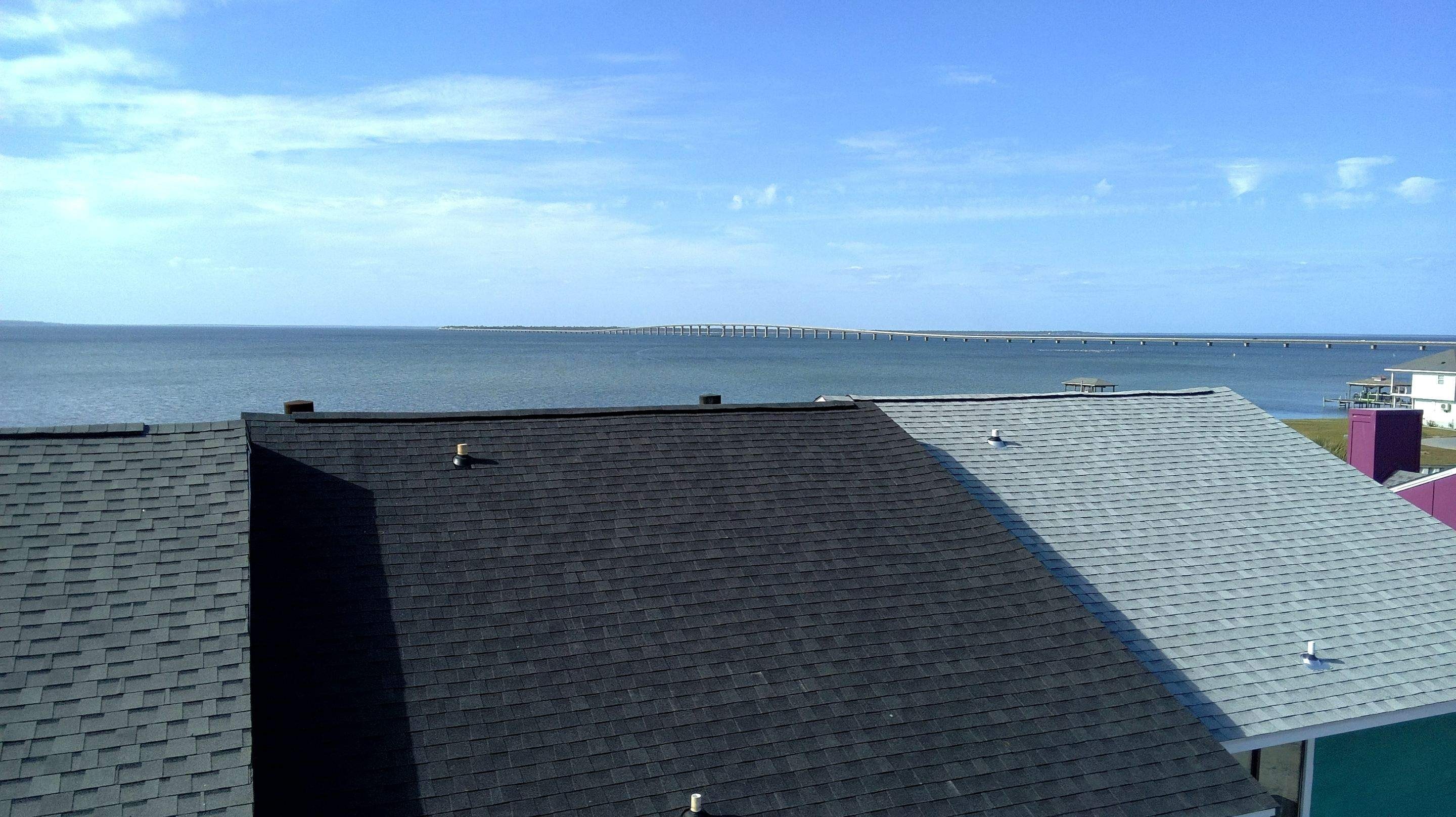
New architectural shingle roofs overlooking Santa Rosa Sound

Reference

Roofing systems, compared honestly

Seven systems, what each one is for, where it does well, and what has to be thought through before choosing it. No lifespan figures and no pricing, because both would be wrong for most buildings.

Steep slope
Asphalt shingle, metal, and tile where the structure carries it.
Low slope
TPO single-ply, modified bitumen, built-up roofing, and coatings over sound substrates.
What you will not find
Lifespan figures or pricing. Both would be wrong for most buildings, and we explain why.

Roofing systems

The right system depends on the building, not the brochure

Slope and geometry, exposure to wind and salt, what the structure can carry, how long you are holding the property, and how the roof needs to look all narrow the field quickly.

Steep-slope, mostly residential

Complex, cut-up roofs with valleys and dormers favor a covering that handles geometry without custom fabrication.

  • Asphalt shingle: the common choice here, and repairable in sections
  • Metal: standing seam hides its fasteners, removing the usual leak path
  • Tile: durable and architecturally specific, but the structure has to carry it

Low-slope, mostly commercial

These roofs fail at their details (drains, penetrations, curbs, terminations), not in the middle of the field.

  • TPO single-ply: heat-welded seams form a continuous membrane
  • Modified bitumen: multiple plies give redundancy under foot traffic
  • Built-up roofing: most often encountered as an existing roof to evaluate
  • Coatings: restoration, and only over a substrate that is genuinely sound

How to choose

Six things that narrow the field before material preference does

Once those six are weighed, most buildings are choosing between one or two systems, not seven.

Roof slope
The single biggest fork. Steep-slope roofs shed water and take shingle, metal or tile. Low-slope roofs hold water briefly and need a membrane with sealed seams. Many buildings have both.
Geometry
Valleys, dormers, hips and wall intersections all need flashing. Complex roofs favor a covering that handles shape without custom fabrication; simple long planes favor panel systems.
Exposure
Distance from the Gulf changes the specification. Salt attacks fasteners, flashing and metal coatings first. Inland, thermal cycling, UV and debris load do more of the work.
Structure
Tile is heavy. A re-cover adds load. What the existing framing can carry is a hard constraint, not a preference, and it is worth establishing before anyone falls in love with a material.
Occupancy
A roof that gets walked on regularly for equipment servicing needs a surface that tolerates traffic. That rules some assemblies in and others out on commercial buildings.
Time horizon
How long you are holding the property is a legitimate input. It changes whether restoring an existing roof or replacing it outright is the better spend.

Steep slope

Systems for pitched roofs

Mostly residential, though steep-slope sections appear on plenty of commercial buildings too.

System 01 · Residential

Asphalt Shingles

Application

The most common residential covering in Northwest Florida, used on sloped roofs of almost any geometry. Architectural (laminated) shingles are the usual choice; three-tab is largely a repair-matching product now.

Where it does well

  • Works on complex roof shapes (valleys, dormers, hips and cut-ups) without custom fabrication
  • Damaged sections can often be repaired without touching the rest of the roof
  • Wide range of wind ratings, so the specification can be matched to your exposure
  • Straightforward to match when a future repair is needed

What to think through

  • Wind performance depends heavily on nailing pattern, starter course and ridge detail; installation matters as much as the product
  • Shaded, slow-drying slopes hold moisture and grow algae faster in this climate
  • Attic ventilation has a direct effect on how the roof performs over time
System 02 · Residential & commercial

Metal Roofing

Application

Standing seam and exposed-fastener panel systems, on both homes and commercial buildings. Common on coastal properties and on simple roof geometries where panel runs are long and uninterrupted.

Where it does well

  • Standing seam hides its fasteners, removing the most common leak path in panel roofing
  • Sheds water quickly, which suits heavy Gulf Coast rainfall
  • Reflective finishes reduce heat gain on unshaded roof planes
  • Panels can be run in long continuous lengths, reducing seams

What to think through

  • Coastal salt exposure drives the coating and fastener specification; this is where a Gulf Breeze roof differs from an inland one
  • Complex roof geometry increases flashing work and cost
  • Exposed-fastener systems need their gaskets inspected periodically; standing seam does not
  • Panel movement with temperature has to be accommodated at the details

System 03 · Residential

Tile Roofing

Ask us

Application

Concrete and clay tile on sloped residential roofs. Less common in the Pensacola area than further south in Florida, but present on specific architectural styles.

Where it does well

  • Very durable surface material that resists UV and does not corrode
  • Individual tiles can be replaced without disturbing the surrounding field
  • Suits the architecture of certain homes in a way other coverings do not

What to think through

  • Heavy: the structure has to be able to carry it, which is a real constraint on re-covers
  • The waterproofing is the underlayment, not the tile; underlayment condition drives when the roof needs work
  • Walking a tile roof causes breakage, so inspection and repair need care

Between the systems

The covering is the part you choose. The details are the part that decides.

Every system above this band sheds water by slope. Gravity carries the rain off the roof, and the covering's job is to keep it moving over the joints instead of through them. When one of these roofs fails, it fails at a seam in that motion: a lifted course, a valley, a wall line.

Every system below holds water briefly on its way to a drain, which changes what failure looks like. A membrane does not shed; it stays sealed or it does not, and its seams, curbs and terminations decide which. The materials change at this line. The rule about details does not.

Fastening
Nailing pattern and starter course set the wind performance. Installation matters as much as the product it fastens.
Flashing
Walls, valleys, curbs and penetrations are where water actually enters. Whatever the covering, this is the boundary the rain keeps testing.
Terminations
Edges and end-laps are where wind starts its work. Uplift loads the perimeter first, before anything in the field moves.

Low slope

Systems for flat and low-slope roofs

These roofs fail at their details: drains, penetrations, curbs, terminations and seams. Membrane choice matters, but detailing decides the outcome.

System 04 · Commercial

TPO Single-Ply

Application

Heat-welded thermoplastic membrane on low-slope commercial roofs. Common on retail, office, light industrial and multi-tenant buildings.

Where it does well

  • Welded seams form a continuous membrane rather than relying on adhesive
  • Reflective white surface reduces heat gain on large unshaded roof areas
  • Repairs and future penetrations can be welded into the existing membrane
  • Works over a range of insulation assemblies, so the R-value can be specified separately

What to think through

  • Seam quality is the whole system; this is installation-dependent work
  • Penetrations, curbs and drains are where low-slope roofs fail; the detail work matters more than the field
  • Requires positive drainage; standing water is a maintenance problem, not a cosmetic one

System 05 · Commercial

Modified Bitumen

Application

Multi-ply asphaltic sheet systems on low-slope roofs, including smaller commercial buildings and the low-slope sections of otherwise sloped residential roofs.

Where it does well

  • Multiple plies provide redundancy: a breach in one layer is not immediately a leak
  • Well-suited to roofs with heavy foot traffic around equipment
  • Granulated cap sheets give a durable, UV-stable surface
  • Repairs are straightforward and the materials are widely available

What to think through

  • Installation method (torch, cold-adhesive, self-adhered) has to suit the building and its occupancy
  • Darker surfaces absorb more heat than a reflective membrane
  • Flashing height and termination detail at walls and curbs is where these systems are won or lost

System 06 · Commercial

Built-Up Roofing (BUR)

Ask us

Application

Alternating layers of bitumen and reinforcing fabric, finished with gravel or a cap sheet. Found on many older low-slope commercial buildings in the area.

Where it does well

  • Multiple redundant layers make it a robust assembly
  • Long track record on low-slope commercial roofs
  • A gravel surface protects the membrane from UV and foot traffic

What to think through

  • Heavy, and installation is disruptive to building occupants
  • A gravel surface makes leak investigation slower, because the membrane is not directly visible
  • Often encountered as an existing roof to be evaluated rather than a new specification

System 07 · Commercial

Roof Coatings

Ask us

Application

Fluid-applied coatings over an existing low-slope roof. A restoration approach, not a replacement, and only appropriate on a substrate that is sound.

Where it does well

  • Can extend the service life of a roof that is watertight but weathering
  • Reflective finishes reduce heat gain
  • Applied without a tear-off, so building operations are less disrupted

What to think through

  • Not every roof qualifies. Wet insulation, failing seams or saturated substrate must be corrected first, because a coating over a wet assembly traps the moisture
  • The existing roof has to be surveyed properly before a coating can be recommended
  • Surface preparation drives the outcome more than the coating product does

The detail work, photographed

What the detail work looks like on a finished roof

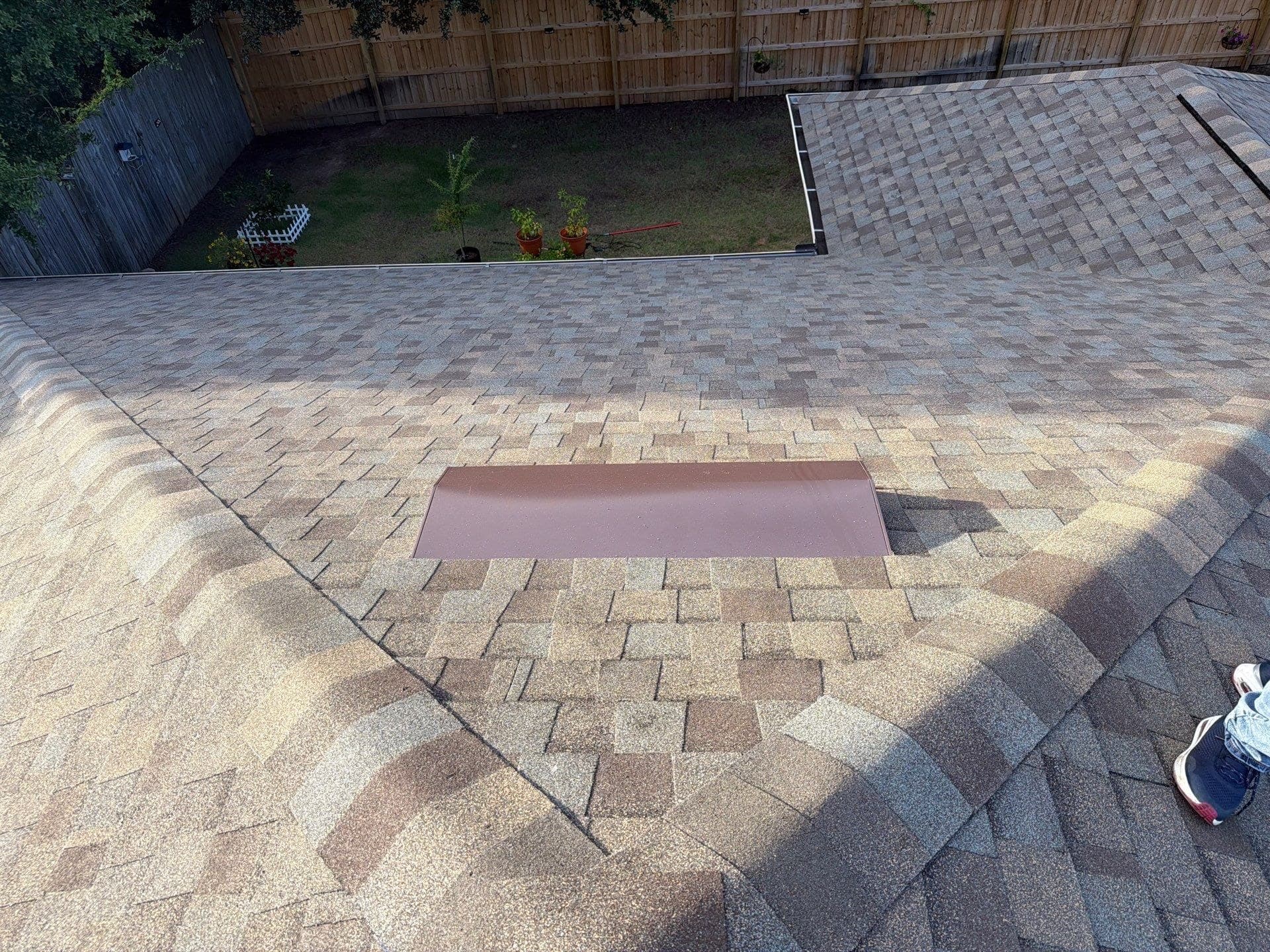
This is a full replacement in Navarre: weathered, algae-streaked shingle taken off to the deck, then a new architectural shingle roof. The covering is what you notice from the street. The skylight is where the factor grid at the top of this page stops being abstract.

Its curbs were re-flashed under new covers rather than reused, because a penetration is a hole in the roof no matter how good the covering around it is. That is the point this page keeps returning to: the flashing, the terminations and the penetrations decide the outcome, on shingle just as much as on a membrane.

New skylight cover flashed into an architectural shingle roof, seen from the ridge
Navarre, FL

A note on what we install

Why some systems here are marked 'ask us'

Plenty of roofing sites list every system in existence and imply they install all of them. It reads well and it is rarely true.

The systems above marked Ask us are ones where the right answer depends on the specific building, and where we would rather have a conversation than let a website make a commitment on our behalf. That is not a hedge; it is the difference between a specification and a brochure.

If you have a building and a problem, describe it. We will tell you which of these is in the running and why the others are not.

For how these play out in practice, see residential roofing or commercial roofing. If you already know the covering is at the end of its life, see what a replacement involves.

Questions

Questions about materials

  1. How do I choose between shingle, metal and tile?

    #

    It depends on the building more than on preference. Roof slope and geometry, how exposed the property is to wind and salt, what the structure can carry, how long you intend to hold the property, and how the roof needs to look all narrow the field quickly. Complex, cut-up roofs favor shingle. Simple, long roof planes and coastal exposure favor metal. Your specific roof gets a walk-through of those trade-offs, not a steer toward one answer.

  2. How long will a new roof last?

    #

    Anyone giving you a single number is guessing. Real service life depends on the material, the quality of the installation, how exposed the roof is, how well the attic is ventilated, and whether the roof is maintained. What we can tell you is what affects longevity on your specific roof, and what we will do about each of those things.

  3. Does being near the water change what roof I should use?

    #

    Yes, and it is one of the more consequential decisions on a coastal property. Salt exposure affects fasteners, flashing and metal coatings well before it affects the covering itself. On homes in Gulf Breeze, Navarre and along the Pensacola Beach corridor, the specification for those components should reflect that exposure. Further inland, in Milton, Pace and Crestview, thermal cycling and debris load matter more than salt.

  4. Can we just coat the roof instead of replacing it?

    #

    Sometimes, but not always, and it depends on what is under the coating. A fluid-applied coating can extend the service life of a roof that is watertight but weathering. It cannot fix wet insulation, failing seams or a saturated substrate. Applied over those, it traps the moisture and hides the problem. The roof has to be surveyed properly before anyone can tell you whether it qualifies.

Not sure which of these applies?

Tell us about the building: slope, age, what is on it now, and what is going wrong. We will narrow it down with you.

Call (850) 361-9761Free estimate