

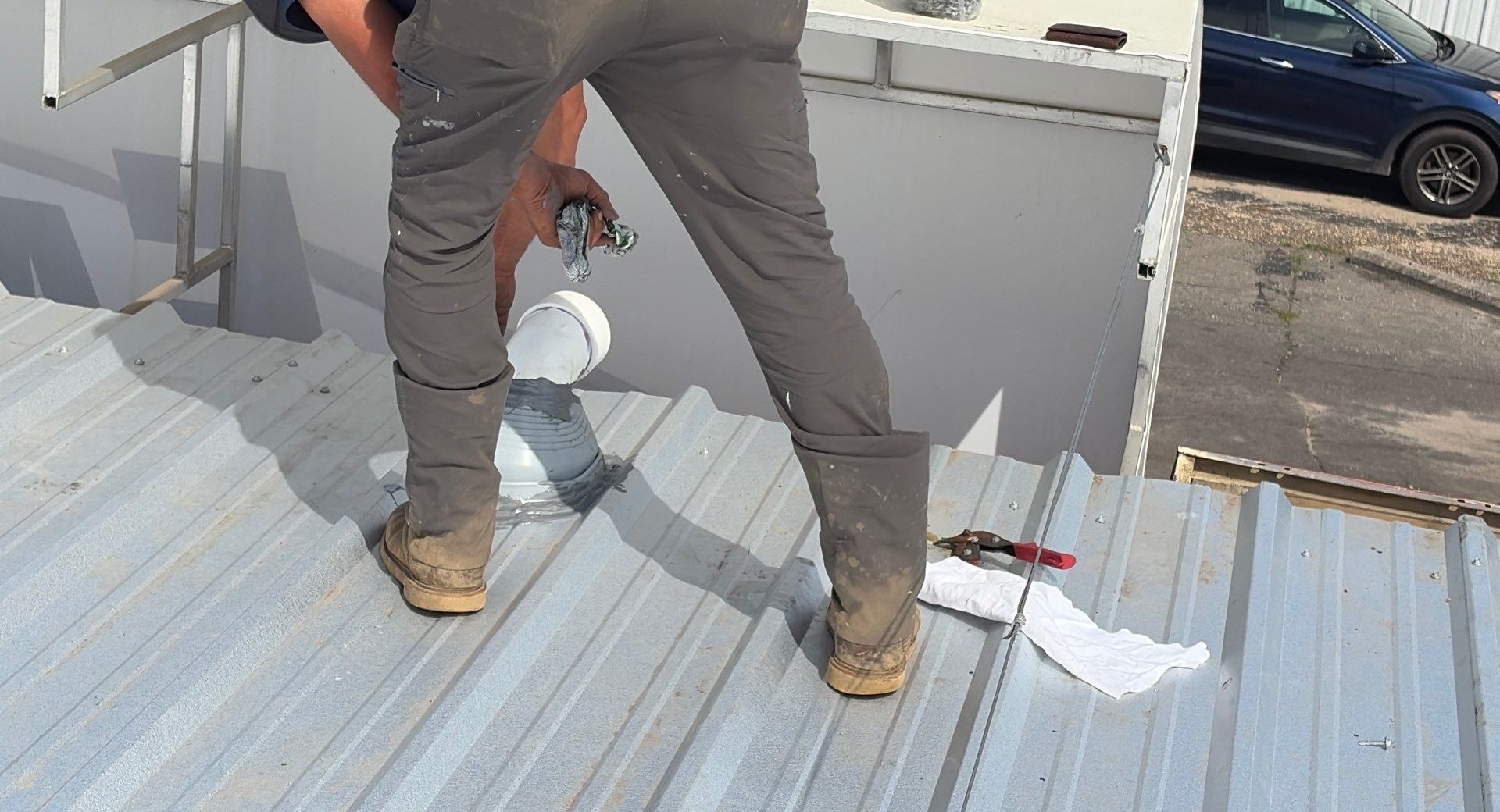
Leaks & storm damage
Something is getting in. Let's find out where.
Roof leak investigation and repair for homes and commercial buildings around Pensacola. We start with what you have observed, because that narrows the search more than anything else.
- Start with
- Where the water appears, when it started, and whether it follows rain or wind from a particular direction.
- We look at
- Penetrations, flashing, valleys, terminations and any recent work, which is where the overwhelming majority of leaks begin.
- You get
- The location, the cause, and photographs. Not a recommendation to replace the whole roof because tracing it was inconvenient.
Warning signs
What you are seeing, and what it usually points at
This is general guidance, not a diagnosis of your roof. Nobody can tell you what is wrong with a specific building from a website. What it can tell you is whether it is time to have someone look.
On a house
- Stains on ceilings or at the top of interior walls, especially ones that grow after rain
- Granules collecting at the bottom of downspouts
- Shingles that are cupped, curled, cracked or missing
- Daylight visible in the attic, or damp insulation
- A ridge line that has stopped looking straight
- Anything new after sustained wind, especially at edges, ridges and hips
On a commercial building
- Ceiling tiles staining, particularly near columns or interior walls
- Water pooling on the roof more than a day or two after rain
- Seams that are lifting, wrinkling or have been patched repeatedly
- Flashing pulling away at parapets, curbs or equipment kerbs
- Blocked or slow drains and scuppers
- New penetrations added by another trade and never properly flashed
Two or three of these together is a reasonable trigger to call. One on its own may be nothing. If water is actively coming in, do not wait to see whether it gets worse. It will. Call (850) 361-9761 and describe what you are seeing. Whether it is a house or a commercial building changes what we check first; the residential and commercial roofing pages cover each in detail.
How it works
From your description to a repair
Four steps. The first one is you talking, and it does more work than people expect.
Describe the symptom
Where the water shows up, when it started, and whether it tracks with heavy rain or with wind from a particular direction. Interior stains mark where water exited, not where it got in, so what you've noticed narrows the search.
We investigate the roof
Penetrations, flashing, valleys, terminations and any recent work come first, because that's where the overwhelming majority of leaks originate. We check the attic or interior where we can get to it.
You see what we found
Photographs and a plain description of the condition and its location, written to be understood by someone who wasn't on the roof.
Repair, or an honest conversation about replacement
If the failure is localized and the rest of the roof is sound, we repair it. If repairs are becoming frequent or the covering is failing generally, we'll tell you that rather than selling you a repair that won't hold.
Why we investigate first
A repair that starts with the right detail
Tar smeared over a leak treats the symptom. The stain marks where the water got out, not where it got in, so the smear holds for a while, then fails wider than the problem it was covering.
That is why step one of our process is finding the entry point, not sealing the exit — then rebuilding the detail the way a full install would. It takes longer than reaching for a bucket of tar, and it is the difference between a repair and a delay.
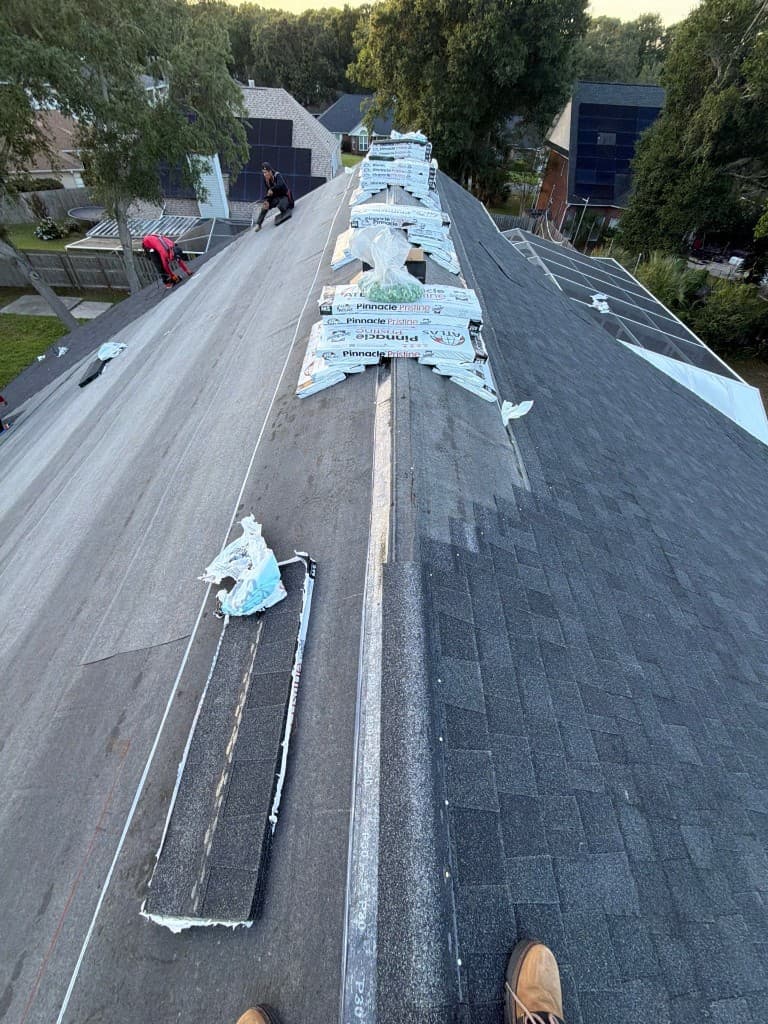
Storm damage
What wind uplift does, and why it is hard to see
The most common thing we hear after a named storm is that the roof seemed fine, and then six weeks later a stain appeared on a bedroom ceiling. That gap is not a coincidence. It is how long it takes for the right combination of rain and wind direction to come along.
If your area took sustained wind, having the roof looked at is reasonable even when nothing is obviously missing. It is a short conversation either way.
- What uplift does
- It breaks the adhesive seal between shingle courses at edges, ridges and hips. Nothing is displaced, so nothing looks wrong from the ground until wind-driven rain gets under the course.
- Why timing matters
- Documenting damage close to the event is materially easier than establishing months later that a leak and a storm are connected.
- What we give you
- Photographs, the location and nature of the damage, and a scope for correcting it. That record is what your insurer needs. We are roofers, not adjusters, and we do not file the claim for you.
Temporary measures
What a tarp can and cannot do
Properly installed, a tarp is a legitimate stopgap. It stops the situation from getting worse while materials, weather and scheduling are sorted out.
What it does not do is address the water already inside the assembly. Wet insulation stays wet. A saturated deck keeps deteriorating. On a low-slope roof, water that has traveled laterally between the membrane and the deck is not going anywhere just because the entry point is covered.
Tarps installed under pressure (nailed through the covering, weighted with whatever was to hand) can create their own penetrations. If a tarp went on in a hurry, mention it when you call.
If you would rather check who you are calling before you call, our project record and license details are on one page.
The bigger question
When a repair stops being the right answer
We would rather repair a roof that can be repaired. But there is a point where spending on repairs is money that would be better put toward the replacement, and pretending otherwise helps nobody.
| Factor | A repair still makes sense | Time to talk about replacement |
|---|---|---|
| The failure | A repair still makes senseLocalized and identifiable: one detail, one area, one event. | Time to talk about replacementShowing up in unrelated places, which points at the system rather than a spot. |
| The surrounding covering | A repair still makes senseSound, shedding water, with life left in it. | Time to talk about replacementGenerally deteriorated: granule loss, cupping, brittleness across the field. |
| How often | A repair still makes senseFirst problem, or the first in years. | Time to talk about replacementThird call in eighteen months, in a different place each time. |
| What it buys you | A repair still makes senseYears of service, and time to plan a replacement on your terms. | Time to talk about replacementA repair here buys months, and you will spend the money again. |
Questions
Repair questions
What happens when you come out for a leak?
#We start with what you have observed (where the water appears, when, and under what conditions) because that narrows the search considerably. Then we look at the roof itself, focusing on penetrations, flashing, valleys, terminations and any recent work, and at the attic or interior where it is accessible. You get what we found, in plain language, with photographs.
My roof looks fine after the storm. Should I still get it checked?
#Wind damage frequently is not visible from the ground. Uplift tends to break the seal on shingles at edges, ridges and hips without displacing them, so the roof looks intact while the next rain finds its way underneath. If your area took sustained wind, having it looked at is reasonable even when nothing is obviously missing.
What can a tarp actually do?
#A properly installed tarp is a temporary measure that limits how much more water gets in while a repair is arranged. It is not a repair. It does not dry out what is already wet, it does not stop damage that has already occurred, and it degrades in sun and wind. Treat it as buying time, and make sure the actual repair is scheduled rather than deferred indefinitely.
Is it worth repairing a roof that is already old?
#Sometimes yes: if the failure is localized, the rest of the roof is sound, and a repair buys you time to plan a replacement properly rather than under pressure. Sometimes no: if repairs are becoming frequent, in unrelated areas, or the underlying material is failing generally, you are spending money that would be better put toward the replacement. We will tell you which situation you are in rather than defaulting to the larger job.
Will the repair match the rest of my roof?
#We will get as close as the available material allows, and we will tell you up front if an exact match is not possible. Shingle colors change over production runs and existing roofs weather, so a repair on an older roof is usually visible on close inspection even when the product is nominally identical.
Do you work with insurance claims?
#We document what we find on your roof: photographs, the location and nature of the damage, and the scope of work needed to correct it. That documentation is what your insurer needs. We are roofers, not public adjusters or your insurance company's representative, so we do not file or negotiate the claim on your behalf.
Describe what you're seeing.
Where the water shows up, when it started, and whether it follows heavy rain or wind from a particular direction. That is enough to start.
Or call us: (850) 361-9761